
“The problem with obsessing over training ROI measurement is that even when it looks good, we're not sure what 'good' really means. And when ROI falls below expectations, simply measuring it doesn't help us improve it.”
Chris Wigglesworth, Founder of Coursecheck.
The importance of investing in training is undeniable. Yet there's an underlying sense in L&D that they need to prove the value of their work.
For years, the gold standard to demonstrate results has been training ROI (Return on Investment). This metric speaks the language of the business: the financial return generated by employee training, measured against its cost. While it’s certainly satisfying to see a positive ROI calculation, what if this obsession with the purely financial is actually stopping L&D from achieving meaningful, long-term success?
At Coursecheck, we believe that the key to effective training evaluation lies in L&D teams and providers focusing less on tracking £ spent and saved/gained and more on achieving continuous training improvement and demonstrating real impact in whatever way makes business sense. This blog explores why the obsession with measuring training ROI is limiting success and shows you how to measure the factors that truly improve performance.
Training ROI vs. training improvement
Training ROI and training improvement are often viewed separately, when in reality they are part of the same process. But training improvement must come first and, in our view, it’s the more important of the two.
Why? There’s little point in calculating the return on investment of any training programme without mechanisms for continuous training improvement.
Training improvement is forward-looking, while training ROI is backward-looking.
And yet, as Chris Wigglesworth, Founder & CEO of Coursecheck, recently told Learning News, the sector has become “excessively preoccupied with calculating ROI,” often at the expense of improving what actually drives results.
Because ROI alone doesn’t improve training. It only reports on it.
Watch Chris' full interview at Learning News:
What is training ROI?
ROI is typically defined as:
ROI = (Benefits – Costs) / Costs
Training ROI is a financial measure that compares the monetary benefits an organisation gains from employee training programmes against their total cost. It attempts to answer the question: Did our investment in training produce a financial return?
The challenges in measuring training ROI
However, measuring ROI in the training industry comes with a set of challenges:
- Many training outcomes don’t translate neatly into pounds.
- Some benefits (e.g., preventing incidents, maintaining compliance, improving employee retention and engagement, career progression, etc) can be defined as more avoided costs than revenue gains.
- The impact of training is heavily dependent on factors outside the control of L&D: line manager support, practice opportunities, systems, culture, and more. Because these conditions are owned by the wider business, improving ROI requires shared ownership, not responsibility placed solely on L&D.
What is training improvement, and why is it more important than training ROI?
Training improvement is the continuous, evidence-based process of enhancing the quality, delivery, relevance, timeliness and impact of training so that learners gain the knowledge and skills they need, and companies achieve better business outcomes from their training investment.
As our Founder explains:
“Alongside measuring outcomes, we need to be equally focused on measuring things that potentially will impact the outcome.”
This is where continuous improvement becomes essential and why it should come before training ROI.
Training improvement usually focuses on refining:
- Training content
- Trainer delivery
- Timing, pacing, and structure
- Real-world relevance
- Accessibility and inclusiveness
- Opportunities for practice
- Getting the right people into the right training at the right time, so new skills can be applied quickly and effectively.
Through strategic focus on these elements, organisations can achieve better learning and development outcomes, which in turn helps training providers create highly effective training programmes that boost customer satisfaction.
What companies get wrong about training impact
The biggest misconceptions and mistakes when it comes to training ROI and the impact of training are:
1. Holding L&D responsible for factors they cannot control
Employee training may equip people with new skills, but the wider business controls:
- Whether learners get immediate opportunities to use their new skills
- Whether managers support the learner
- Whether processes aid the new way of working
And if learners don’t have the chance to apply those new skills, the impact will be minimal, and ROI will be effectively zero, which is another reason the wider business must share responsibility for training outcomes.
Expecting L&D to deliver financial outcomes alone is both unrealistic and counterproductive. As Chris stresses:
“The outcome of training is so much about more than the training courses… the whole organisation needs to get behind it.”
2. Not getting involved early, especially in survey design
Feedback questions must be designed to generate objective, actionable data and include forward-looking elements.
3. Assuming ROI = impact
Some wrongly assume that if we can’t measure ROI in monetary terms, the training has no impact. ROI is a financial metric, expressed as a percentage or ratio. Impact, on the other hand, refers to behaviour change, skill acquisition, better decision making, higher employee engagement and retention, etc. These outcomes are not financial numbers; they are human changes. Training impact often influences ROI, but it is not the same thing.
4. Defining success in isolation rather than collaboratively
Training evaluation becomes performative rather than meaningful.
The consequences of getting these aspects wrong are that:
1. You hit a wall and stop improving. ROI doesn’t highlight:
- What needs fixing
- What enables impact
- Where learning experiences fall short
By only focusing on ROI, companies and training providers will never know what needs improving, and because of that, they won't be able to improve performance and business outcomes.
2. Everyone becomes disappointed. Targets aren’t met, L&D gets blamed, and the organisation assumes “training doesn’t work”, even when the real issue lies elsewhere.
How to drive continuous training improvement and ensure success
To achieve meaningful training impact, organisations need to focus on the drivers of improvement rather than the financial outputs alone. The steps below outline how to create the conditions where training can succeed and ultimately deliver measurable outcomes.
Here’s how to shift the mindset:
1. Start with the end in mind: Instead of asking, "What is the ROI?", collaboratively define success by asking, "If this training is successful, what do we expect to observe?" Then work backwards to identify:
- The behaviours that will indicate success
- The environmental conditions required
- What the business must own
- The feedback required from training participants, managers, and sponsors.
2. Establish benchmarks for success: decide not only what to measure but what result constitutes success, and define 'Good': Set clear, quantifiable targets upfront (e.g., "80% of learners must feel comfortable applying new skills").
3. Establish a clear baseline. To measure improvement meaningfully, organisations also need a clear baseline. Without understanding the starting point, it’s impossible to demonstrate what has changed or whether the training has made a measurable difference. Establishing that baseline and deciding who is responsible for capturing it, is essential before any improvement work begins.
4. Make it a business goal: Training sessions are just one element. If you are going to measure the impact of training, the wider business needs to own the responsibility for providing the environment and support needed for the new knowledge and skills to stick. It’s unreasonable to expect L&D to demonstrate ROI when the business controls many of the levers needed for impact.
5. Turn data into actionable insights: To effectively turn training feedback into improvement, organisations must balance macro-level and micro-level analysis to inform overall strategy, potentially addressing factors outside the training itself (e.g., support or timing). Actionable insights also depend on asking clear, unambiguous (e.g. What could we do differently next time?). Designing your feedback forms correctly allows you to do just that: answer key strategic questions and take targeted actions.
6. Measure the drivers, not just the outcome: You can measure training outcomes forever, but it won’t improve them unless you measure the drivers of improvement. This means looking beyond basic scores.
Measuring success drivers with Coursecheck AI-powered analysis
So, how do you measure these drivers of improvement effectively? First of all, you need to find the truth behind the scores. In the training industry, this is often easier because instructors can collect feedback on the spot and get 100% response rates, which results in a high-quality data set that genuinely reflects the learner experience.
When it comes to feedback, you’ll have score-based questions, but you’ll also have free-text questions. At Coursecheck, we often say that it’s free-text the responses that provide the richest insight that might otherwise be missed.
“It’s often the free text questions where the treasure lies… You get real insight from that in a way you can’t from the numbers.”
If you can understand what people are saying in their own words, you get real quality insight in a way you can’t from just the numbers. When you are operating at scale, running a large programme over many months, you may have hundreds or thousands of comments. That's a task you can’t do manually.
Collect, analyse and improve training feedback at scale with Coursecheck.
Analyse complex free-text responses at scale and turn data into actionable insights
This is where AI comes in. It’s not just about doing something faster; it’s doing something that you could never have done before. AI allows you to take raw, qualitative data and create structured reports that pinpoint the exact issues, whether they are gaps in the skills and knowledge delivered or issues with the practice environment.
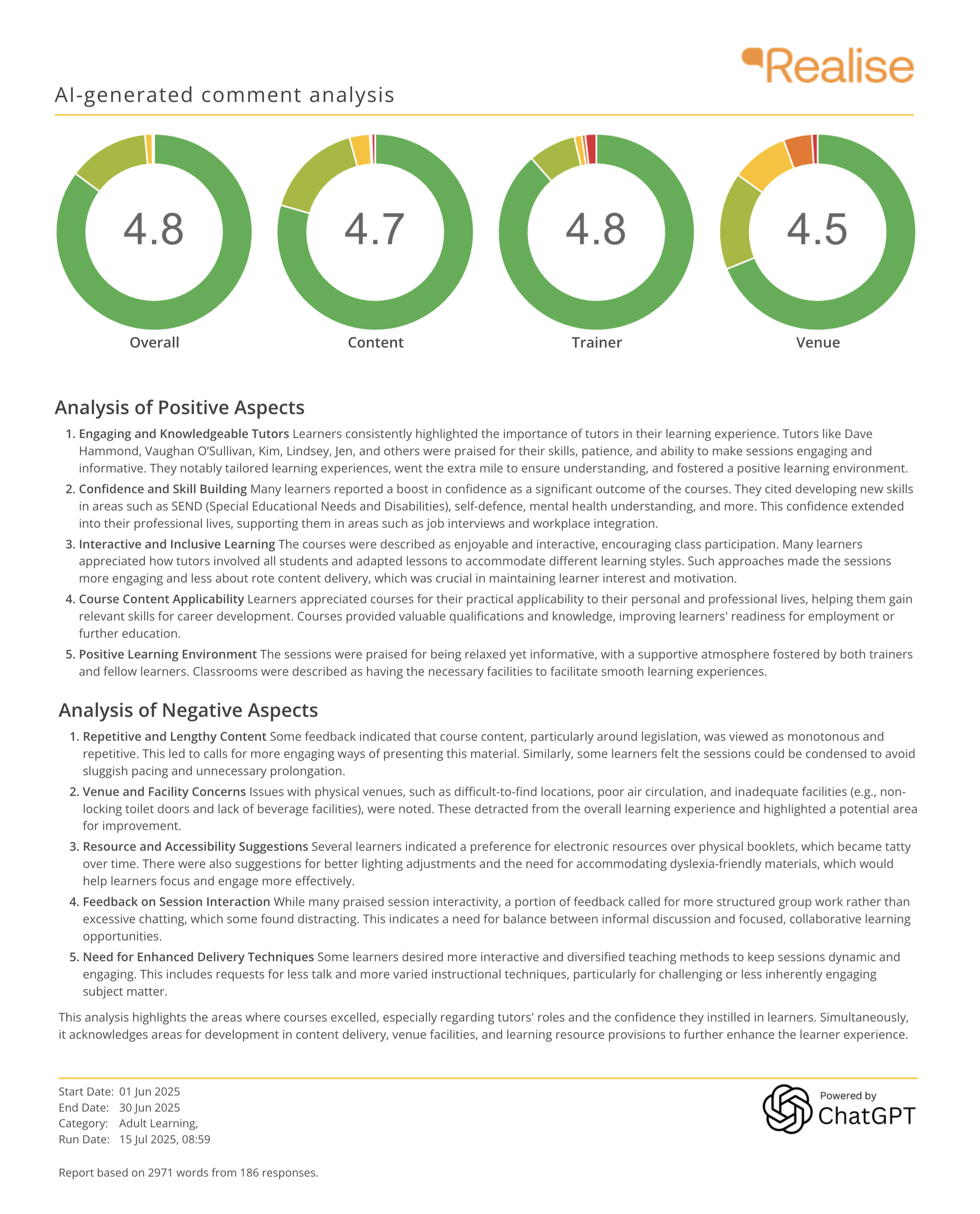
Specifically, the AI-powered feedback analysis within Coursecheck can instantly deliver structured, actionable insights by producing concise, digestible summaries of qualitative feedback across multiple levels:
- Course-level analysis: clarifies what's working (or not) by highlighting positive and negative feedback, tracking trends, and suggesting actionable steps for improvement.
- Question-level analysis measures real impact by drilling into open-ended responses, grouping similar answers to show which training aspects drive behaviour change.
- Trainer-level reports summarise feedback across sessions to identify recurring strengths, opportunities and track a trainer's performance over time.
Realise is a real-world example of a national training provider that turns thousands of learner comments into actionable insights by using Coursecheck’s AI-powered feedback analysis. This case study shows how effective training evaluation enables faster decision-making, improved training quality, and measurable gains in learner satisfaction and achievement rates.
Training improvement comes first; Training ROI comes second
Improvement is what actually drives more impactful training.
There is nothing wrong with measuring the ROI of employee training, so long as it isn’t the only metric, and so long as it isn't used to replace the real work of understanding and improving learning experiences.
ROI calculation makes sense only after you’ve established:
- A realistic definition of impact
- Shared ownership between L&D and the wider business
- Evidence that improvements have been made
- A clear chain linking training to behaviour to outcomes
Training improvement also needs to be a continuous cycle rather than a one-off exercise. Each round of feedback and refinement strengthens the next, and ROI then becomes a way of validating whether those improvements have genuinely made a difference.
Otherwise, ROI becomes performative; a spreadsheet exercise with little organisational value.
When organisations balance their focus between proving value and improving value, ROI becomes more worthwhile to measure.
Collect feedback, demonstrate training quality, improve delivery and win more business with Coursecheck.