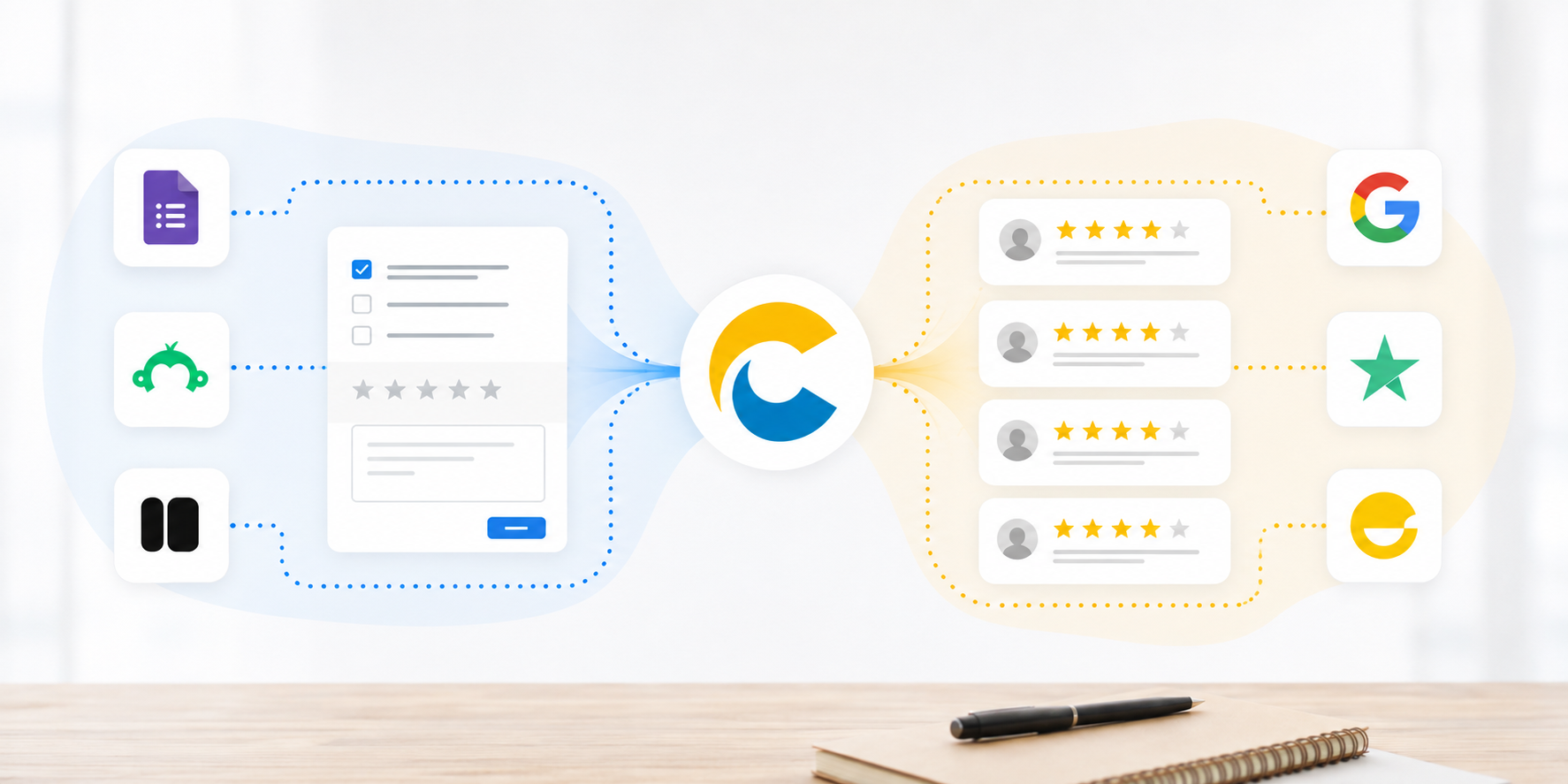
If you run training courses, you probably already collect feedback in more than one way. Maybe you use Trustpilot or Google Reviews for your public reputation, and SurveyMonkey or Google Forms for end-of-course surveys. There's nothing wrong with that approach. But as your business grows, managing separate tools for feedback and reviews can become increasingly time-consuming.
The challenge is that learner feedback and public reviews serve different purposes. Feedback helps you understand what's working and where training can be improved. Reviews help demonstrate the quality of your training to prospective buyers. Many training providers end up running two separate processes to achieve both, creating extra administration for the training provider and extra effort for the learner.
Neither type of tool was designed to support the entire training feedback process, from collecting learner feedback and turning it into actionable insights, to demonstrating the quality of your training through independently collected reviews.
This article compares review platforms and survey tools to explain what each does well, where the gaps are for training companies, and how a training-specific platform like Coursecheck brings those activities together in one connected workflow.
What's the Difference Between a Survey Tool, a Review Platform, and Coursecheck?
Before comparing features, it helps to be clear on what each type of tool is actually built to do.
Survey tools like SurveyMonkey and Google Forms are flexible, general-purpose data-collection tools. They can be configured for almost any kind of survey, from a staff engagement poll to a customer satisfaction check-in, with a blank canvas for each new survey.
Review platforms like Trustpilot and Google Reviews are public-facing tools to evidence overall company reputation. They give customers a place to leave a rating and a comment, and they give you a profile page that anyone can find when they search your company name. They're built for one job: showing the world what people generally think of your business.
Coursecheck combines the functionality of a survey tool and a review platform in a solution built specifically for training providers. It collects learner feedback, enables independently collected reviews to be published, and connects every response to the relevant course, trainer and client.
Instead of simply collecting survey responses or displaying public reviews, Coursecheck helps you identify trends, compare performance and uncover opportunities to improve the quality of your training, while independently collected reviews provide proof of its value to prospective buyers.
Where General Survey Tools Fall Short for Training Providers
SurveyMonkey and Google Forms are flexible and genuinely useful tools for a one-off survey. They're easy to configure, and don't require any special training to use. For an occasional post-event poll, they do the job well.
The challenge comes when you're delivering training at scale and want to analyse feedback across multiple events. As the number of courses, learners and clients grows, managing feedback with a generic survey tool can become increasingly time-consuming.
Surveys need to be created and distributed to trainers and learners. Responses need to be linked to the correct training event. Data then needs to be exported, analysed and often reformatted into reports or presentations before it can be shared with colleagues or clients. As the volume of feedback grows, so does the administration and analysis effort.
The more training you deliver, the harder it becomes to spot meaningful patterns in the feedback.
For example, could you quickly see that ratings for one course have gradually declined over the past six months? Or that a particular client consistently scores one aspect of your training lower than others? How easily could you identify a trainer receiving exceptional feedback, or understand what learners value most about their delivery?
Collecting feedback is only the first step. The real value comes from understanding it, spotting trends and acting on what learners tell you.
Generic survey tools are excellent at collecting responses, but training providers often have to build the processes for analysing, reporting and sharing that feedback themselves.
There is also no automatic route from a positive survey response to public proof of quality. If you want to use customer reviews to market your training courses, you'll typically need a separate process to collect and publish those reviews, often asking learners to provide feedback twice.
Where General Review Platforms Fall Short for Training Providers
Trustpilot and Google Reviews are genuinely strong for building trust. If someone searches for your company, a solid star rating and a page of reviews provides reassurance before they've read a word of your website. That visibility is valuable, even if you also invest in a training-specific platform.
Where they start to fall short is when someone is deciding whether to book a particular course. A buyer comparing two Excel courses doesn't just want to know your overall rating. They want to know what learners thought of the specific course they're considering.
For training buyers, context matters. A review linked to a particular course gives far more confidence than a general company rating alone.
There's also the question of how reviews are collected and verified. Verification standards vary between review platforms, and buyers are increasingly aware that online reviews don't always tell the whole story. For training providers, independently collected reviews linked to genuine learners and specific training events can provide stronger evidence than general company reviews alone.
It's similar to buying a laptop online. A retailer's overall rating tells you whether they're trustworthy to buy from, while the product reviews help you decide whether a particular laptop is right for you. Training buyers make similar decisions. They want confidence in the provider, but they also want evidence that the specific course they're considering delivers a great learning experience. Understanding that distinction is important when you're choosing the right reviews platform for your training business.
How Coursecheck Closes the Gap Between Review Platforms and Survey Tools
The comparison between survey tools and review platforms isn't about choosing one instead of the other. It's about understanding where each one fits. Coursecheck combines the strengths of both, while adding automation, analysis and training-specific functionality that general-purpose tools weren't designed to provide.
The comparison below highlights the key differences.
| Capability | Coursecheck | General review platforms | General survey tools |
|---|---|---|---|
| Collect feedback | ✓ | ✓ | ✓ |
| Analyse feedback by trainer, course and client | ✓ | ✕ | ✕ |
| Track trends and improvements over time | ✓ | ✕ | ✕ |
| Automatically create and distribute survey links and QR codes | ✓ | ✕ | Partial |
| Automated alerts and reports | ✓ | ✕ | ✕ |
| Shareable reports for clients and stakeholders | ✓ | ✕ | Partial (basic export only) |
| Respond directly to learner feedback | ✓ | Partial (public reply only) | ✕ |
| Measure training impact through follow-up feedback | ✓ | ✕ | ✕ |
| Training management system integrations | ✓ | ✕ | Rare / requires custom set-up |
| Verified reviews that boost search visibility | ✓ | ✓ | ✕ |
| Course-level reviews visible in Google search results | ✓ | ✕ | ✕ |
| Public-facing course and provider profile pages | ✓ | ✕ | ✕ |
With Coursecheck, survey links and QR codes are automatically created and distributed to trainers, removing manual administration and making it easier for learners to provide feedback while the course is still fresh in their minds.
Because feedback is automatically linked to the relevant course, trainer and client, trends can be identified without manually exporting and combining survey responses. If ratings for a course start to decline, or a trainer consistently receives exceptional feedback, those patterns become much easier to spot and act on.
Coursecheck also supports follow-up feedback, helping training providers measure what happened after the course rather than just how learners felt on the day. That provides a clearer picture of whether the training changed confidence, knowledge or workplace behaviour.
The same feedback can then be published as independently collected reviews on public course and provider pages, helping prospective buyers make informed decisions. This brings learner feedback and online review management for training providers into a single process, avoiding duplicate requests for feedback and reducing survey fatigue.

Review platform, survey tool or Coursecheck: how should you choose?
The right choice depends on what you're trying to achieve. In many cases, training providers will use more than one tool, because review platforms, survey tools and training feedback platforms each solve different problems.
If your priority is company-wide reputation and branded search visibility, a general review platform like Trustpilot or Google Reviews still does that job well. Many training providers continue to use one alongside a more specialist training feedback platform.
If you need a flexible one-off survey, for something outside the training feedback loop like an internal staff poll, a general survey tool like SurveyMonkey remains a sensible choice.
If what you need is ongoing, automated, course-level feedback that can be analysed, used to improve training, and published as independent proof of quality, that's the job Coursecheck was built to do.
Conclusion
Review platforms and survey tools both have an important role to play. But if you want a single solution that collects learner feedback, turns it into actionable insights and provides independently collected reviews as proof of quality, you need a training-specific platform like Coursecheck.
By bringing those activities together, training providers can spend less time managing feedback and more time using it to improve training and demonstrate its value.
Discover how Coursecheck helps training providers collect, manage and showcase learner feedback.
Frequently Asked Questions
How do you collect learner feedback after training?
The most common way to collect learner feedback is through an end-of-course survey, accessed via a QR code or email link. Keeping it short and easy to complete helps maximise response rates while the training is still fresh in learners' minds. Many training providers also use a follow-up survey a few weeks later to measure longer-term training impact.
For training providers delivering multiple courses, it's important that feedback is automatically linked to the relevant course, trainer and client. This makes it easier to analyse results, identify trends and use feedback to improve future training.
Can learner feedback also be used as public reviews?
Yes. With a specialist training feedback platform, positive learner feedback can be published as independently collected reviews on public course and provider pages. This means the same feedback process helps improve training while also providing trusted social proof for prospective buyers, without asking learners to complete a separate review.
Is Google Reviews enough for a training provider?
Google Reviews can play an important role in building trust and improving your company's visibility in search results. However, they are designed to reflect your overall business reputation rather than the quality of individual training courses.
Many training providers therefore use Google Reviews alongside a specialist training feedback platform. This allows them to collect structured learner feedback, analyse results by course and trainer, and publish independently collected course and provider reviews that give prospective buyers more relevant information.